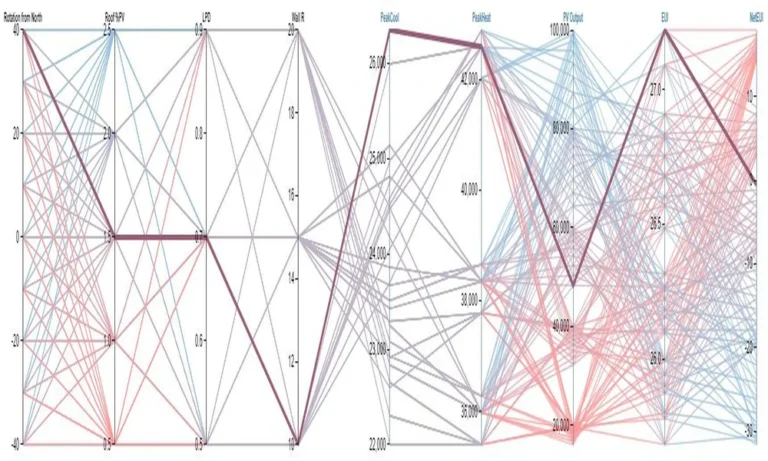
When it comes to making design decisions, there are many factors to consider and innumerable scenarios for each project. While the ideal scenario must fit within the project budget, two related considerations are lifetime operating costs and energy use. With so many possibilities, how do we help our clients make the best decisions? A key tool we use at Cushing Terrell is energy modeling.
With energy models, we review potential building performance scenarios long before construction and afterward through our post-occupancy evaluation (POE) process. POEs give us the opportunity to make further refinements and upgrades as systems age or as new technology is developed. It’s also important to check our assumptions against the actual data to continually improve future comparisons.
What do we look at? We combine factors such as building orientation, weather patterns, construction materials, HVAC systems, and building-use predictions, among many others. Then we analyze the data and make adjustments to find the right balance between cost and energy-use options for each project. To get an idea of how it works, I describe three projects below, looking at what the energy models told us, the design decisions made related to energy use, and how the facilities are operating today.
NorthWestern Energy — Montana Headquarters | Butte, Montana
The five-story, 98,000 sq. ft. Montana headquarters for NorthWestern Energy was designed with a couple high-priority goals in mind: 1) create an attractive place for people to work, reflecting the company’s culture and 100-year history in the community, and 2) demonstrate a commitment to sustainable, energy-efficient operations. Awarded LEED Gold certification for new construction, the project included systems that utilize indoor evaporative cooling, heat recovery, an under-floor air-distribution system, energy-efficient lighting, and advanced lighting controls to maximize performance and reduce operating costs. Mosaic was the lead design firm, while Cushing Terrell provided mechanical, electrical, plumbing, and fire protection design services.
The energy analysis for this project focused on providing the right heating and cooling solutions for each type of space. Under-floor air-distribution systems give occupants control over their temperature and airflow patterns, providing individualized comfort. Excess heat, generated by spaces such as data rooms, is used to warm up cold ventilation air in the winter. Overall, the energy modeling efforts in this case were largely aimed at making decisions to optimize mechanical systems for both energy efficiency and occupant comfort.
What the data told us then
- Under-floor air-distribution systems reduce energy consumption by heating and cooling people instead of entire spaces.
- Heat recovery systems are key to reducing energy consumption during cold Montana winters.
- The building energy use intensity (EUI) was predicted to be 51.4 kBTU/sq. ft. per year.
- The building would reduce energy costs by about 20% over a minimally code-compliant building.
And what it tells us today
- Actual EUI is 49.3 kBTU/sq. ft. per year, 4.3% less than predicted.
- Actual data varies by month, mostly due to seasonal weather variations.
- Office spaces like this one have predictable usage patterns, which help energy modeling accuracy.
- Assumptions and mathematical models closely match reality.
Ada County — 911 Dispatch Center | Meridian, Idaho
For the 25,000 sq. ft. Ada County 911 Dispatch Center, our team designed a new facility for 911 dispatch as well as new electrical and mechanical systems to reduce energy consumption. The design solution needed to be energy-conscious and 21% below ASHRAE 90.1, while still meeting the needs of the emergency dispatch staff. Aspects of this project that were key to the design considerations were the heat-generating data center and building use as the dispatch center operates 24/7, 168 hours per week.
The team designed an in-row cooling system for the data center using a modulating chiller unit along with a modulating in-row fan system. The team also used variable refrigerant flow (VRF) for the administration portion of the building. The electrical system used for the dispatch and data center is redundant with a hot-swappable component so the system will not have to shut down for servicing or replacement of parts. Additionally, the high-tech workstations for dispatchers allow for individualized climate control in order to adjust heating and cooling as needed.
Early energy models explored all aspects of the building, including the thermal envelope, orientation, lighting, and HVAC systems. These models showed that the data center and HVAC systems had the greatest impact on performance. The energy modeling process led to the addition of the free-cooling chiller module that uses cold outdoor air to cool the data center without introducing outdoor contaminants. The energy model was then used to obtain utility incentives for the mechanical equipment, partially offsetting the additional costs of the more efficient equipment.
To wrap up
These three projects illustrate our process of identifying different variables and opportunities, implementing the best options based on the data at hand, and checking our assumptions following occupancy to see how the buildings are performing. Energy models allow us to identify solutions that meet our clients’ needs as well as show economic and energy impacts. Additionally, they help us procure funding opportunities, such as utility incentives, to decrease investment costs.